As an Amazon Associate, we earn from qualifying purchases. Some links on this site are affiliate links at no extra cost to you. Our recommendations are based on thorough research and editorial judgment.

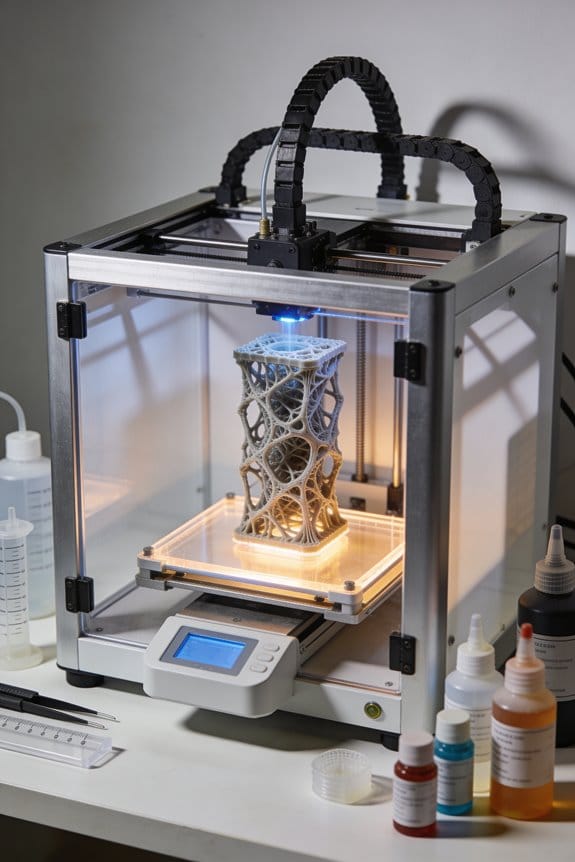
Bioprinting Tissues: The Intersection of 3D Printing and Cellular Biology

You stared at your blank CAD file wondering how to place tiny vascular channels so cells won’t starve, or why your printed construct collapses after a day. You’ve tried different bioinks and nozzle speeds but still lose most cells during printing. Most people assume matching one material property fixes viability, so they focus narrowly on stiffness or printability. This article will show you step-by-step how to design CAD zones for cells and channels, select scaffolds or hydrogels by porosity and sterilization needs, and tune bioink rheology and nozzle settings to maximize cell survival.
You’ll also get practical protocols for making perfusable channels and maturing constructs in bioreactors for reliable, repeatable tissue growth. It’s easier than it looks.
Key Takeaways
Here’s what actually happens when you try to bioprint a tissue: you want a scaffold, cells, and a process that keeps those cells alive and functioning.
- You’ll merge a CAD scaffold with a cell-laden bioink so the printed shape and internal microarchitecture match the tissue you want; for example, print a 10 mm × 10 mm cartilage patch with 300–500 µm porous channels to allow nutrient flow.
- Tip: export your CAD as STL at 50–100 µm resolution for most extrusion systems.
Before you pick a printing modality, you should know how each affects resolution and cells.
- Choose extrusion, inkjet, laser, or light-based printing based on resolution, bioink viscosity, and cell density. For instance, use extrusion if your bioink viscosity is 30–6,000 Pa·s and you need to print cell densities of 1–20 million cells/mL; use inkjet for low-viscosity (<20 mPa·s) inks and lower cell loads (≤1 million cells/mL).
- Example: to print a liver-mimetic droplet array, use droplet/inkjet to place 100–200 nL droplets with ~0.5–1 million cells/mL per droplet.
You need to optimize the bioink because mechanics and chemistry tell cells what to do.
– Why it matters: cells sense stiffness and crosslinking, which changes differentiation and function.
Steps:
- Measure rheology: target shear thinning behavior with a yield stress of 10–200 Pa for shape fidelity.
- Tune stiffness: aim for 0.5–1 kPa for brain, 10–50 kPa for cartilage.
- Pick crosslinking: use ionic (e.g., Ca2+ for alginate) or photo-crosslinking (e.g., 5–10 mW/cm² for 10–60 seconds with LAP) depending on cell sensitivity.
– Example: for a bone-like construct, add 5–10% (w/v) gelatin-methacryloyl and photopolymerize at 10 mW/cm² for 30 seconds to reach ~20 kPa.
You must solve oxygen and nutrient limits so cells beyond ~200 µm survive.
– Why it matters: diffusion limits kill cells beyond ~200 µm without perfusion.
Steps:
- Design perfusable channels 100–1,000 µm in diameter into your CAD.
- Use sacrificial inks (e.g., Pluronic F127) printed at 4°C then flushed at 4–10°C to leave hollow channels.
- Connect to a bioreactor and perfuse at 0.1–5 mL/min depending on construct size.
– Example: a 10 mm × 10 mm cardiac patch with 300 µm channels perfused at 1 mL/min maintains viable tissue for weeks.
Validate and iterate so your prints become reproducible.
– Why it matters: without validation you can’t trust function or reproducibility.
Steps:
- Do pilot prints: print 3–5 small test pieces (5–10 mm) to check geometry.
- Run viability assays: use live/dead staining at 24 hours and 7 days, quantify % live cells aiming for ≥80% at 24 hours.
- Record rheology and print parameters: extrusion pressure (kPa), nozzle diameter (e.g., 200–400 µm), print speed (2–20 mm/s).
- Iterate CAD and settings until print variance is <10% in key dimensions.
– Example: after three pilot runs adjusting pressure from 40 to 60 kPa and speed from 8 to 12 mm/s, your scaffold porosity stabilized at 45% ± 3%.
Keep this checklist for your next run:
- CAD export: STL, 50–100 µm.
- Bioink target: viscosity, yield stress, stiffness (with numbers above).
- Channel size: 100–1,000 µm.
- Perfusion: 0.1–5 mL/min.
- Validation: 3–5 pilots, ≥80% viability at 24 hours, <10% dimensional variance.
If you follow those steps, you’ll have a clear, repeatable path from design to a perfused, viable construct.
Bioprinting Workflow: CAD, Deposition, and Maturation
Here’s what actually happens when you design the blueprint for a bioprint.
Why it matters: a clear digital plan keeps cells where they need to be so your tissue functions. Start with CAD and do these steps: 1) sketch the gross shape, 2) map zones for cell types and materials, 3) assign porosity and channel sizes (use 100–500 µm for perfusable channels). Example: design a small vascularized skin patch 20 × 20 mm with 200 µm microchannels for blood flow. Use the CAD to validate that your structures are printable and set layer height to 50–200 µm depending on nozzle size. When you finish, export STL or G-code.
Before you program the printer, you need to know the bioink behavior.
Why it matters: the printer settings turn your blueprint into reality without killing cells. Do this: 1) measure bioink viscosity and shear-thinning profile (report viscosity at 0.1 and 100 s⁻¹), 2) pick nozzle diameter (100–400 µm), 3) set extrusion pressure or flow rate, 4) define printhead paths and layer sequence, 5) choose crosslinking timing and intensity. Example: for a gelatin-methacrylate ink at 10% w/v, set nozzle 200 µm, extrusion pressure 30–60 kPa, and UV crosslink for 10–20 seconds at 10 mW/cm² per layer. Save these parameters as a print profile for repeatability.
Think of deposition like placing puzzle pieces precisely.
Why it matters: layer-by-layer deposition determines spatial cell density and microstructure. Steps: 1) load cell-laden bioink at 4–25 million cells/mL depending on tissue, 2) print at ambient or cooled cartridge temp (example: print gelatin blends at 15–20°C), 3) maintain print speed (5–20 mm/s) to match extrusion, 4) control strand spacing to reach target porosity (e.g., 200 µm spacing for 60% porosity). Example: when printing cardiac patches, aim for 10–20 million cardiomyocytes/mL and align strands to guide contraction. Check viability immediately with live/dead staining.
If you’ve ever watched a seedling grow, this is why maturation matters.
Why it matters: maturation supplies nutrients and cues so printed constructs become functional tissues. Do this: 1) transfer constructs into a bioreactor within 1–4 hours, 2) set media perfusion rate (start 0.5–5 mL/min depending on channel size), 3) program mechanical or electrical stimulation if needed (example: cardiac tissue—1 Hz pacing at 2–5 V/cm after day 3), 4) monitor pH, O2, and glucose daily. Example: mature a bone-like construct for 21–28 days with perfusion at 1 mL/min and intermittent 1% compressive strain for 1 hour/day. Record functional readouts like contractile force, ECM deposition, or mineralization.
Each stage has measurable parameters you can iterate on.
Why it matters: tracking numbers makes your results reproducible. Do this: 1) log CAD dimensions and export files, 2) save print profiles and bioink rheology, 3) record cell density and viability, 4) archive bioreactor settings and assay results. Example: keep a spreadsheet row per run with nozzle, pressure, temp, cell density, viability %, and maturity day metrics. Small parameter changes—5–10%—can make big biological differences.
Which Bioprinting Technique to Choose (Criteria and Use Cases)

Before you pick a bioprinting technique, know why it matters: your choice determines whether the tissue will survive, function, and be manufacturable.
Think of tissue needs like a recipe: cells are the ingredients, bioink is the batter, and the printer is the oven. If you’re making a small vascular patch with endothelial cells, you might need micron-scale precision; if you’re printing a cartilage plug, you need high-cell-density filaments that bear load. Example: printing a 2 mm-diameter capillary network for a liver-on-chip requires <20 µm feature control around fragile endothelial cells.
Why cell sensitivity matters: fragile cells die with harsh shear or heat. Laser-assisted bioprinting gives very high cell viability and can place single cells precisely. Example: researchers use laser-assisted printheads to deposit individual stem cells into patterns for neural microtissues.
Why viscosity and cell density matter: extrusion printers handle viscous, cell-rich bioinks like alginate–gelatin blends at 10–30% solids and cell densities >10^7 cells/mL, but they blur fine detail. Example: printing a 6 mm cartilage disc with 20% GelMA uses extrusion to keep structure under load.
Why droplet control matters: inkjet is fast and good for droplet placement but needs low-viscosity bioinks (<10 mPa·s) and lower cell densities (<10^6 cells/mL). Example: using inkjet to deposit growth factor-laden droplets (picoliter to nanoliter) onto a scaffold for gradient formation.
Why photopolymer compatibility matters: light-based methods (DLP, stereolithography) give features under 20 µm and smooth scaffold surfaces, but require photocrosslinkable resins and careful UV exposure so cells survive. Example: printing microfluidic scaffold channels 10–15 µm wide with DLP using PEGDA-based bioresin and 405 nm light.
How to choose—step-by-step:
1. Define the biological goal and constraint in one sentence. (E.g., “Create a 5 mm vascularized patch with endothelial cells that stay >80% viable after 7 days.”)
2. Set three quantifiable specs: target resolution (µm), cell density (cells/mL), and allowable viscosity (mPa·s).
3. Match specs to methods:
- If resolution <20 µm and you can use photocurable materials → choose light-based.
- If single-cell placement and max viability are required → choose laser-assisted.
- If you need to print viscous, load-bearing, high-cell-density constructs → choose extrusion.
- If you need fast droplet dispensing with low-viscosity inks → choose inkjet.
4. Check practical constraints: does your lab need portability? If yes, favor compact extrusion or modified inkjet systems; if not, bench-top DLP or laser systems give larger build volumes.
5. Do a quick pilot: print a 5 x 5 x 1 mm test piece with your intended bioink and measure viability and feature fidelity within 48 hours.
Example decision: you want a 10 mm hydrogel scaffold with 15 µm channel features seeded with fragile hepatocytes. Specs: resolution 15 µm, cell density 5×10^6 cells/mL, viscosity <50 mPa·s. Pick a light-based DLP system with a cell-friendly PEGDA formulation and use low-intensity 405 nm exposure for short pulses.
Quick tradeoffs to remember:
- Laser-assisted = highest viability, precise cell placement, slower and more complex.
- Extrusion = robust for viscous, cell-dense inks and structural parts, lower fine resolution (~100 µm).
- Inkjet = fast droplet placement, limited to low viscosity and lower cell densities.
- Light-based = sub-20 µm features, needs photocurable materials and care with light dose.
If you want, tell me the tissue, target size, cell type, and rough bioink viscosity, and I’ll recommend a specific technique and a pilot protocol.
Bioinks and Materials: Hydrogels, Scaffolds, and Hybrid Systems

Before you pick materials for bioprinting, know this: the materials decide if your printed tissue will hold shape, keep cells alive, and become functional.
I’ll explain what bioinks and scaffolds are and why they matter for bioprinting, because the materials you choose determine whether a printed tissue will hold its shape, let cells survive, and mature into a functioning construct. Use hydrogels when you want a cell-friendly matrix; they mimic soft tissue water content and let nutrients diffuse, but you must tune stiffness and degradation. For example, mix 2–4% (w/v) alginate with 0.5–1% gelatin to get a printable gel that supports many cell types. Rigid scaffolds give structural support and shape guidance, yet design them porous—aim for 100–300 µm pores—to let cells infiltrate; think of a 3D-printed PLA frame with 60% porosity used in bone prototypes. Hybrid systems combine both to balance mechanics and biology; a typical approach is a PLA lattice printed at 200 µm filament diameter filled with a 3% collagen hydrogel carrying cells. Sterilize bioinks by filtering through 0.22 µm when possible, or use UV exposure for surface sterilization, because contamination wrecks cultures fast. Surface treatments, like immunomodulatory coatings, can reduce immune response and encourage integration; for example, coat a scaffold with 100 µg/cm2 hyaluronic acid to lower macrophage activation.
Why you should tune hydrogel stiffness: stiffness controls cell fate and mechanics in one go. If you want stem cells to become neural, aim for 0.1–1 kPa; for cartilage, target 10–50 kPa. Try rheology tests: measure storage modulus G’ at 1 Hz.
How to design scaffold porosity in practice: porosity affects nutrient flow and cell migration. Steps:
- Choose target pore size (100–300 µm for most cells).
- Design lattice with CAD, setting strut spacing accordingly.
- Print a test piece and verify pore size under 10x magnification.
- Adjust filament diameter or spacing and reprint until within ±10%.
A real-world example: a researcher printed a PLA lattice (200 µm filament) with 65% porosity, filled it with 3% collagen seeded with fibroblasts, sterilized by ethanol rinse and UV, and saw infiltration across 2 mm in 7 days.
How to combine hydrogels and rigid scaffolds practically: hybrids give you both mechanics and biology. Steps:
- Print scaffold at room temp on a cooled bed if needed.
- Crosslink scaffold if required (e.g., heat or UV).
- Cast or co-print hydrogel-cell mix at 4°C to 37°C depending on gelation.
- Crosslink hydrogel (Ca2+ bath for alginate or thermal gelation for gelatin).
- Culture under appropriate flow or static conditions.
Example: print a PCL frame, dip it into 2% alginate with keratinocytes, crosslink in 100 mM CaCl2 for 3 minutes, and culture under gentle rocking.
How to sterilize bioinks and scaffolds without killing cells: sterilization matters because contamination ruins experiments. If you’re working with cells, filter liquids through 0.22 µm syringe filters; for solids, autoclave if material tolerates it (PLA warps, PCL survives), or use 70% ethanol rinse plus 30 minutes of UV. Always test cell viability after sterilization—run a live/dead assay at 24 hours.
Example: for a collagen hydrogel, sterilize by dissolving in sterile acid, filter, neutralize inside a sterile hood, and use within 24 hours to avoid degradation.
How surface treatments affect immune response: coatings change how the body sees your implant. For instance, coating with 100–200 µg/mL polyethylene glycol (PEG) can reduce protein adsorption and lower inflammation. Apply by dip-coating for 2 minutes and air-dry under sterile conditions.
Final practical checklist:
- Pick hydrogel base and set concentration (e.g., alginate 2–4%, gelatin 5–10%).
- Define target stiffness and measure G’.
- Design scaffold pore size (100–300 µm) and test under magnification.
- Sterilize: liquids via 0.22 µm filter; solids via autoclave or ethanol+UV as compatible.
- Combine scaffold and hydrogel using the 5-step hybrid sequence above.
- Validate with viability and infiltration assays at 24 hours and 7 days.
If you follow these concrete steps, you’ll avoid common failures and get reproducible printed constructs.
Applications: Vascularized Tissues, Nerve Grafts, and In Situ Printing

If you’ve ever stared at a sponge and wondered how to keep cells alive inside it, this section explains why vascular networks matter: without perfusable channels and endothelial lining, thick tissue constructs die within a few hundred micrometers of their surface. In practice, you create channels (0.1–1 mm diameter) and seed them with endothelial cells so fluid can flow through and carry oxygen, nutrients, and waste away. Example: a 5‑mm thick liver patch printed with 400‑micron channels perfused at 1–2 mL/min kept hepatocytes viable for seven days in vitro. Steps:
- Design channels spaced 300–600 µm apart for oxygen diffusion.
- Print or cast channels 0.2–1 mm wide depending on flow needs.
- Line channels with endothelial cells at 1–5 million cells/mL and perfuse at physiologic shear (0.5–2 dyn/cm2).
If you do this, your construct will stay viable and integrate faster in vivo.
Think of nerve grafts like a set of train tracks: axons need straight, aligned guidance to cross injury gaps, otherwise they wander and fail to reconnect. You should aim for aligned channels 100–300 µm wide with surfaces that support Schwann cells and optionally deliver growth factors. Example: a 10‑mm rat sciatic nerve gap repaired with a conduit having 200‑µm aligned microchannels and seeded with Schwann cells restored measurable motor function in 8–12 weeks. Steps:
- Mold or print channels oriented along the intended nerve axis.
- Seed with Schwann cells at ~1–2 million cells/mL or add a stem cell population that differentiates into supportive cells.
- Optionally load slow‑release NGF/BDNF at 10–100 ng per conduit for the first 2–4 weeks.
Do this and axons have guidance cues and trophic support to bridge the gap.
Before you print onto a wound, know why in situ printing speeds healing: placing bioinks directly reduces cell transit time, matches irregular geometry, and can modulate the local immune response. For a handheld or robotic printer, choose a bioink that gels within 10–60 seconds, degrades over weeks, and releases anti‑inflammatory cues early on. Example: a diabetic foot ulcer treated with a printable hydrogel loaded with mesenchymal stem cells and IL‑10 reduced inflammation and closed the wound in four weeks versus standard care. Steps:
- Select a shear‑thinning bioink that crosslinks on demand (e.g., alginate + Ca2+ or gelatin methacrylate with UV for <60 s).
- Tune degradation to 2–8 weeks to match tissue regrowth.
- Include immune‑modulating signals (e.g., 10–50 ng/mL IL‑10 or MSCs at 1–5 million/mL).
If you match gelation, degradation, and signaling, your printed material will stay put and promote faster healing.
Challenges and Next Steps: Vascularization, Multicellularity, and Hybrid Printers

Think of supplying blood like plumbing a house: if you don’t get pipes to every room, parts go cold and die.
Vascularization matters because cells beyond ~200 micrometers from a nutrient source die quickly. Do this in three concrete steps:
- Design perfusable channels in your CAD model at 200–500 µm spacing so diffusion reaches all cells.
- Print sacrificial filaments (e.g., Pluronic F127) in a lattice, embed with your cell-laden bioink, then dissolve the sacrificial material at 4–20°C to leave channels.
- Seed those channels with endothelial cells at 1–5 million cells/mL and perfuse at 1–10 dyn/cm² shear stress to encourage lining formation.
Real-world example: a lab printed a 1 cm-thick cardiac patch with 300 µm channels, flushed Pluronic out in 10 minutes, and achieved beating tissue after 7 days under perfusion.
If you’ve ever tried to place many cell types, this is why precise mapping matters.
Multicellularity matters because misplaced cells don’t form functioning tissue. Follow these steps:
- Map cell locations in CAD, assigning each region a cell type and density (e.g., fibroblasts 0.5–1M/mL, cardiomyocytes 5–10M/mL).
- Prepare tuned bioinks—stiffer (5–20 kPa) for structural zones, softer (0.5–3 kPa) for parenchyma—and test printability at extrusion pressures of 5–20 kPa.
- Control local microenvironments with gradients of adhesion peptides (e.g., RGD 0–2 mM) and growth factors delivered by microspheres.
Example: engineers printed a skin construct with keratinocytes on top and fibroblasts below, using a 1 mm-thick softer layer for fibroblasts and a 200 µm stiffer epidermal layer.
The fastest way to combine tools isn’t just buying hardware.
Hybrid printers matter because combining extrusion, inkjet, and laser lets you balance strength and viability. Do this practically:
- Choose which method for each function—use extrusion for dense scaffolds, inkjet for spot deposition of growth factors at 10–100 pL drops, and laser for high-resolution patterning under 50 µm.
- Calibrate coordinate systems: run a 5 × 5 grid print and measure offsets; correct software offsets to under 50 µm error.
- Sequence operations so cells see minimal stress—print structural scaffold first, then deposit cells, then apply light-based crosslinking at ≤10 mW/mm² to avoid damage.
Real-world example: a group printed a composite bone scaffold by extruding PCL at 80–100°C, then inkjetting MSCs into micro-wells, achieving 90% cell viability after 48 hours.
Before you push toward the clinic, regulatory clarity speeds adoption.
Clinical translation matters because without it your device won’t reach patients. Do these three things:
- Define the product class early with regulators and document whether the construct is a device, biologic, or combination.
- Standardize testing—perform mechanical tests (compression at 1 mm/min), sterility assays (USP <71>), and functional assays with at least n=6 replicates.
- Use reproducible bioreactor maturation protocols: control oxygen at 5% ±1%, perfusion flow at 0.5–5 mL/min, and maturation time windows (e.g., 7, 14, 21 days).
Example: a team secured an IDE by submitting data from three lots matured under identical 14-day perfusion runs at 2 mL/min.
If you follow these actionable steps—design perfusable channels, map and tune multicellular prints, integrate hybrid systems with tight calibration, and prepare regulator-ready data—you’ll remove the most immediate roadblocks to printing thicker, functional tissues.
Frequently Asked Questions
What Regulatory Approvals Are Needed for Clinical Bioprinted Tissues?
You need regulatory pathways like device, biologic, or combination product approvals, plus phased clinical trials demonstrating safety and efficacy; I’ll work with regulators (e.g., FDA/EMA), submit IND/IDE/MAA documentation, and follow postmarket surveillance.
How Are Patient-Specific Immunogenic Responses Evaluated Pre-Implantation?
Want reassurance before implanting? I run immune profiling, test donor matching in vitro with patient immune cells against the construct, use cytokine assays and T‑cell activation tests, and iterate bioink or cells to reduce rejection.
What Are Typical Costs and Reimbursement Pathways for Bioprinted Therapies?
I estimate cost estimates vary widely—from tens of thousands for simple grafts to millions for complex organs—and I explain reimbursement pathways: mix of insurance coding, CMS approvals, value‑based contracts, and clinical trial or hospital funding bridges.
How Scalable Is Bioprinting for Commercial Manufacturing of Organs?
Like tending a fragile orchard, I’d say scalability’s promising but constrained: scaling limitations in vascularization, bioink consistency, and regulatory throughput slow growth, though production automation and multimodal printers steadily expand commercial organ manufacturing potential.
What Ethical Guidelines Govern Creation of Brain or Germline-Like Constructs?
They’re governed by ethical frameworks emphasizing harm prevention, transparency, and strict consent models, and I follow oversight, review boards, and moratoria on creating sentient brain-like or heritable germline constructs unless rigorous justification, consent, and safeguards exist.